API Development: CRUD, Pagination & Best Practices Guide
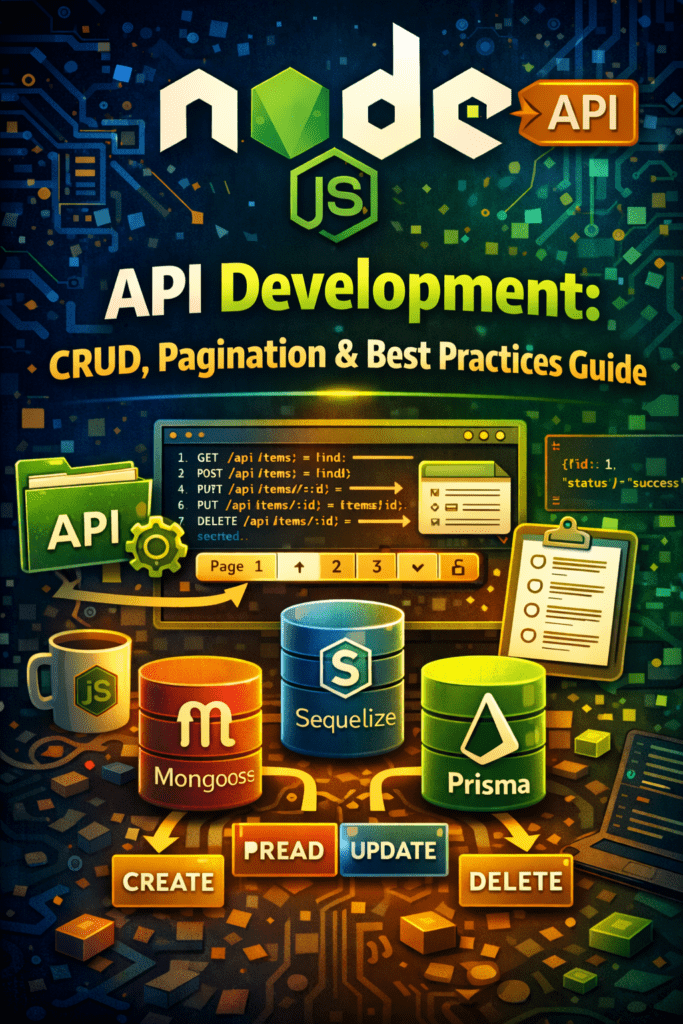
API Development: A Practical Guide with CRUD & Best Practices
Embarking on API development can seem daunting, but with a structured approach and clear understanding of core concepts, it becomes a manageable and rewarding endeavor. This guide provides a practical overview, covering everything from building a CRUD API with MongoDB to implementing pagination, search, and best practices for organizing your API project.
Building a CRUD API with MongoDB
Creating a CRUD (Create, Read, Update, Delete) API is fundamental to many applications. Using MongoDB as our database provides flexibility and scalability.
“`javascript
// Example code (Illustrative)
app.post(‘/items’, async (req, res) => {
// Create a new item in MongoDB
});
app.get(‘/items/:id’, async (req, res) => {
// Read an item from MongoDB
});
// … similar code for PUT (Update) and DELETE
“`
(Image 1: Code snippet illustrating a CRUD operation in an API. Alt text: “Code example of a CRUD operation for API Development using MongoDB.”)
In order to ensure a great end-user experience, it’s vital to implement pagination.
Pagination, Search, and Filtering
As your dataset grows, pagination becomes essential for efficient data retrieval. Search and filtering enhance the user experience by allowing them to quickly find specific information.
Here’s how you might implement pagination:
“`javascript
app.get(‘/items’, async (req, res) => {
const page = parseInt(req.query.page) || 1;
const limit = parseInt(req.query.limit) || 10;
// Query MongoDB with skip and limit for pagination
});
“`
Search and filtering can be implemented by dynamically building queries based on request parameters. For instance, a request can contain multiple parameters used as filter parameters.
API Versioning Strategies
API development isn’t a one-time task; it requires ongoing maintenance and evolution. API versioning ensures backward compatibility as you introduce new features or make breaking changes. Common strategies include:
- URI Versioning: Including the version number in the URL (e.g., `/v1/items`).
- Header Versioning: Using custom headers to specify the API version (e.g., `X-API-Version: 2`).
- Media Type Versioning: Specifying the version in the `Accept` header.
(Image 2: Diagram showing API versioning strategies. Alt text: “Diagram explaining different API versioning techniques in API Development.”)
Best Practices for API Folder Structure
A well-organized folder structure is crucial for maintainability, especially as your API grows in complexity. Here’s a suggested structure:
- `controllers`: Contains route handling logic.
- `models`: Defines data models.
- `routes`: Defines API endpoints.
- `middleware`: Contains middleware functions (e.g., authentication).
- `config`: Configuration files.
- `utils`: Utility functions.
(Image 3: Folder structure of a well-organized API project. Alt text: “Well-structured API project folder system for maintainable API Development.”)
Securing Your API
Security is paramount in API development. Implement authentication (verifying the user’s identity) and authorization (determining what the user is allowed to do). Use industry-standard protocols like JWT (JSON Web Tokens) for secure authentication. Always validate and sanitize user input to prevent injection attacks. Rate limiting can prevent abuse and denial-of-service attacks.
Testing and Documentation
Thorough testing is crucial for ensuring the reliability of your API. Use unit tests to verify individual components and integration tests to ensure that different parts of the system work together correctly. Comprehensive documentation is essential for developers who will be using your API. Tools like Swagger/OpenAPI can help you generate interactive documentation from your API code.
Choosing the Right Technologies
Selecting the right technologies for your API development depends on your specific requirements. Node.js with Express is a popular choice for building RESTful APIs. Python with Flask or Django is another viable option. Databases like MongoDB offer flexibility, while relational databases like PostgreSQL provide strong data integrity.
Conclusion: Mastering API Development
Effective API development requires a solid understanding of core principles, best practices, and the right tools. By focusing on building CRUD APIs, implementing pagination and search, managing API versions effectively, structuring your project carefully, and prioritizing security, you can create robust and maintainable APIs that meet the demands of modern applications.
FAQ
API development involves creating interfaces that allow different software systems to communicate and exchange data. It is important because it enables integration, improves efficiency, and fosters innovation.
You can create a CRUD API using Node.js, Express, and MongoDB by defining routes for creating, reading, updating, and deleting data in your MongoDB database. Mongoose simplifies interactions with MongoDB.
API versioning allows you to make changes to your API without breaking existing applications that rely on it. It provides backward compatibility and enables a smooth transition for users.
Pagination can be implemented by using `skip` and `limit` in your database queries. Filtering can be achieved by dynamically building queries based on request parameters.
Best practices include implementing authentication and authorization, using JWT, validating user input, and implementing rate limiting.
Middleware functions perform various tasks, like logging, authentication, authorization, and request validation, before the route handler is executed.
REST APIs offer stateless communication by leveraging HTTP methods, resource-based URLs, and standardized data formats, such as JSON, enabling scalability and interoperability that is not present in all other architectural styles.
Ready to build powerful APIs? Start your next API Development project today! Explore our resources and get started! Node.js App Testing: Unit, Integration & TDD with Jest Node.js Logging: Morgan, Winston, Cloud – Simplified! Node.js Tools: Nodemon, PM2, ESLint & More! Node.js Authentication: JWT, Refresh Tokens, OAuth & Roles Complete Express.js: Build Scalable Web Apps with the… Database CRUD with Express: Mongoose, Sequelize, Prisma Node.js Core Concepts Explained | Developer's Guide Node.js Basics: Understanding the Core Concepts Advanced Livewire Lifecycle Hooks and SPA-like Navigation in Livewire 3.0 Real-Time Search and Filtering in Livewire 3.0 Building a Real-Time Chat Application with Livewire 3.0 Creating Multi-Step Forms in Livewire 3.0 Creating Dynamic Modals in Livewire 3.0
