Database CRUD with Express: Mongoose, Sequelize, Prisma
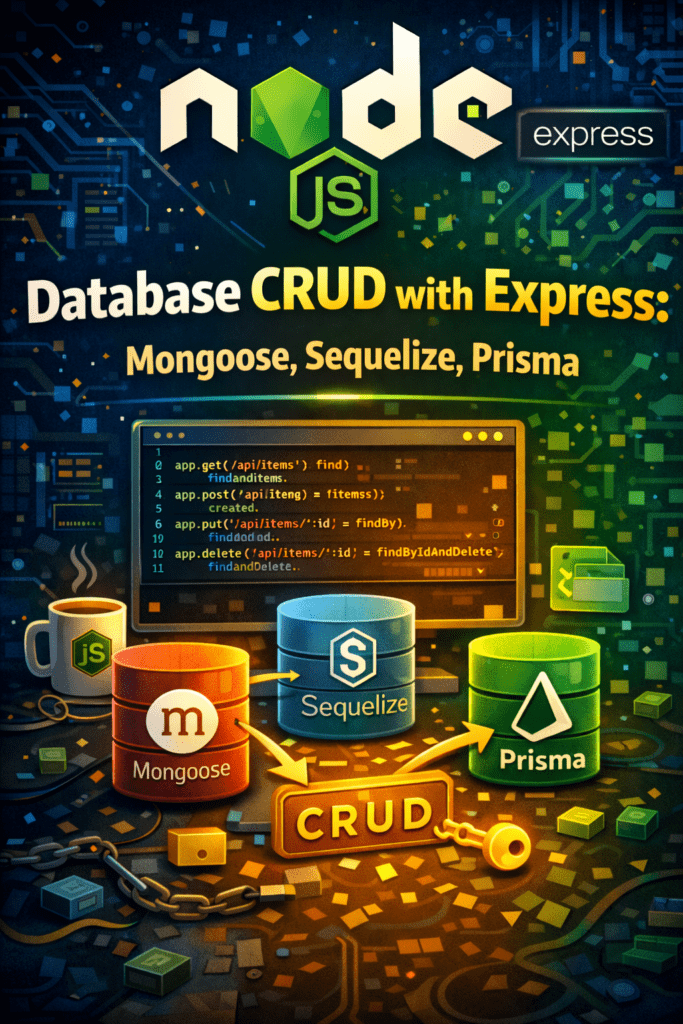
Mastering Database CRUD Operations with Express.js
Working with databases is fundamental to building robust web applications. In this guide, we’ll explore database CRUD (Create, Read, Update, Delete) operations using Express.js, covering popular tools and techniques like Mongoose for MongoDB, Sequelize for MySQL/PostgreSQL, Prisma ORM, and basic Redis caching strategies.
Mongoose: MongoDB and Express.js Best Friends
Mongoose is an Object Data Modeling (ODM) library for MongoDB and Node.js. It provides a straightforward way to interact with your MongoDB database. It handles schemas, validation, and query building, making database CRUD operations simpler. For instance, defining schemas become easy and structured. Therefore, you have better control over your data.
Creating a MongoDB Model with Mongoose
First, you need to define a schema representing your data structure. This schema outlines the fields, data types, and validation rules for your MongoDB documents.
“`javascript
const mongoose = require(‘mongoose’);
const productSchema = new mongoose.Schema({
name: String,
price: Number,
description: String
});
const Product = mongoose.model(‘Product’, productSchema);
“`
Image Description: Code snippet examples showcasing CRUD operations using Mongoose. Alt text: “Mongoose code example for creating, reading, updating, and deleting documents in MongoDB.”
Now, creating, reading, updating, and deleting become simple Mongoose methods.
Sequelize: ORM for MySQL and PostgreSQL
Sequelize is a powerful Object-Relational Mapping (ORM) tool for Node.js supporting databases like MySQL, PostgreSQL, SQLite, and MariaDB. Similar to Mongoose, Sequelize simplifies database CRUD operations by mapping database tables to JavaScript objects.
Defining a Sequelize Model
With Sequelize, you define models representing your database tables. These models have properties that map to table columns.
“`javascript
const { Sequelize, DataTypes } = require(‘sequelize’);
const sequelize = new Sequelize(‘database’, ‘user’, ‘password’, {
dialect: ‘mysql’ // or ‘postgres’
});
const Product = sequelize.define(‘Product’, {
name: DataTypes.STRING,
price: DataTypes.FLOAT,
description: DataTypes.TEXT
});
“`
Image Description: Code snippets demonstrating CRUD operations using Sequelize with MySQL/PostgreSQL. Alt text: “Sequelize ORM code example showing CRUD operations on a MySQL database.”
Sequelize helps you write complex database operations, like associations and transactions, with relative ease.
Prisma ORM: Type-Safe Database Access
Prisma is a modern ORM that provides a type-safe and intuitive way to access your database. It supports databases like PostgreSQL, MySQL, SQLite, SQL Server, and MongoDB. It offers a visual data browser and migration tools.
Prisma Schema and Client
Prisma uses a declarative schema to define your data model and generate a type-safe client for accessing your database. This improves development speed and reduces errors.
“`prisma
// schema.prisma
datasource db {
provider = “postgresql”
url = env(“DATABASE_URL”)
}
generator client {
provider = “prisma-client-js”
}
model Product {
id Int @id @default(autoincrement())
name String
price Float
description String
}
“`
Image Description: A visual representation of the Prisma ORM data modeling and querying process. Alt text: “Prisma ORM schema definition and query example.”
Prisma accelerates development. Its intuitive API reduces boilerplate code.
Redis Caching Basics for Performance
Redis is an in-memory data store often used for caching. Implementing Redis caching can significantly improve the performance of your Express.js applications by reducing the load on your primary database.
Basic Redis Implementation
When a request comes in, check if the data is already in the Redis cache. If so, return the cached data. Otherwise, fetch the data from the database, store it in Redis, and then return it.
Image Description: A simple illustration showing how Redis caching works between an application and a database. Alt text: “Diagram explaining how Redis caching improves database performance.”
Caching reduces the database hits for frequent reads.
Choosing the Right Tool
Each tool has its strengths. Mongoose is ideal for MongoDB’s flexible document structure. Sequelize offers robust SQL ORM features. Prisma offers advanced type safety and ease of use. Redis caching adds crucial performance gains.
Conclusion: Streamlining Database CRUD with Express.js
Mastering database CRUD operations with Express.js involves choosing the right tools for the job. By understanding Mongoose, Sequelize, Prisma, and Redis caching, you can build efficient and scalable applications. Pick the solution that aligns with your project’s specific needs, and never be afraid to experiment!
FAQ: Database CRUD and Express.js
Call to Action: Ready to build scalable and efficient web applications? Dive deeper into database CRUD with Express.js by exploring our advanced tutorials and code examples! Learn more now! Node.js Task Scheduling: Cron Jobs & Queues Made Easy API Development: CRUD, Pagination & Best Practices Guide Real-Time Search and Filtering in Livewire 3.0 Introduction to Laravel Livewire
