Node.js Microservices: Build Scalable Apps
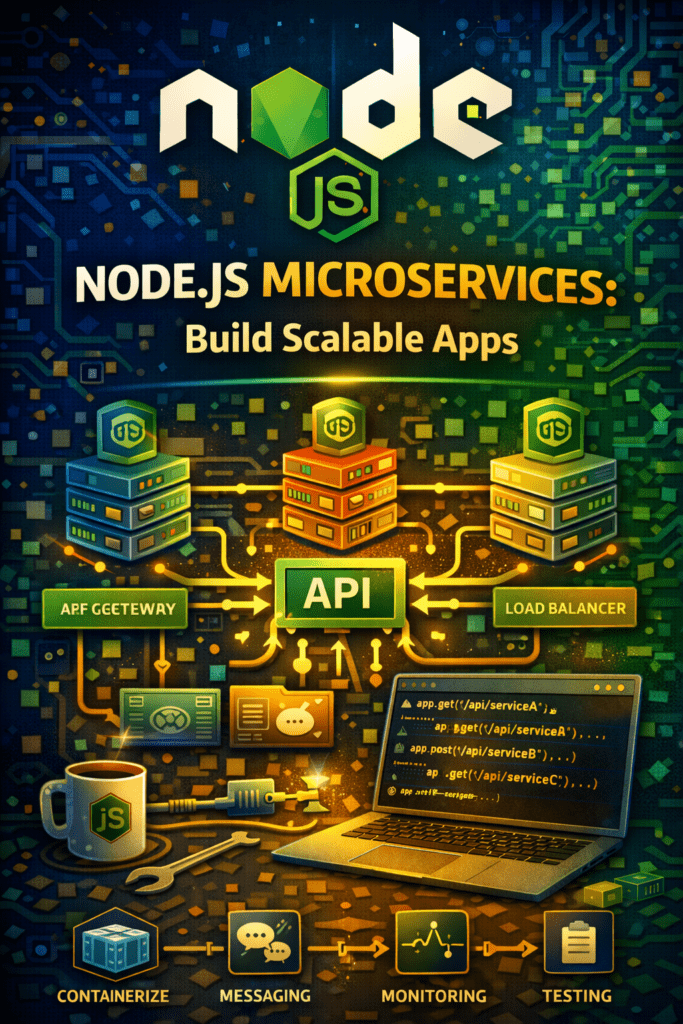
Node.js with Microservices: Architecture and Implementation
The rise of complex applications has led to the adoption of microservices architecture. This approach breaks down large, monolithic applications into smaller, independent services. Leveraging Node.js microservices can offer significant advantages in terms of scalability, maintainability, and development agility.
This article delves into the core concepts of microservices, explores the use of message brokers like RabbitMQ and Kafka, introduces API gateways, and examines event-driven architecture with Node.js.
What are Microservices?
Microservices represent an architectural style where an application is structured as a collection of loosely coupled, independently deployable services. Each service focuses on a specific business capability and communicates with other services through well-defined APIs.
This separation of concerns allows teams to develop, deploy, and scale services independently, reducing the risk of impacting the entire application. Furthermore, it promotes the use of different technologies for different services, adapting to each service’s specific needs.
Using Message Brokers (RabbitMQ, Kafka)
Communication between microservices often occurs asynchronously through message brokers. RabbitMQ and Kafka are popular choices.
- RabbitMQ: A lightweight message broker that implements the Advanced Message Queuing Protocol (AMQP). It is suitable for tasks that require reliable message delivery and complex routing.
- Kafka: A distributed streaming platform designed for high-throughput, fault-tolerant streaming of data. It’s better suited for event sourcing and real-time data pipelines.
Choosing the right message broker depends on the specific requirements of your Node.js microservices application. For example, if strict message ordering is required, Kafka might be preferred.
Implementing RabbitMQ with Node.js
Using RabbitMQ in your Node.js microservices involves setting up a connection, defining queues, publishing messages, and consuming messages. There are several Node.js libraries, such as `amqplib`, that simplify this process.
API Gateway Introduction
An API gateway acts as a single entry point for all client requests, routing them to the appropriate microservices. It simplifies the client-side interaction, providing a unified interface and handling cross-cutting concerns like authentication, authorization, and rate limiting. Implementing an API Gateway simplifies and secures the interaction between your frontend applications and your backend microservices. This architecture also promotes decoupling and flexibility.
Event-Driven Architecture with Node.js
In an event-driven architecture, microservices communicate by publishing and subscribing to events. When a service performs an action, it emits an event that other interested services can consume. This approach promotes loose coupling and allows services to react to changes in other parts of the system.
Benefits of Event-Driven Microservices
An event-driven approach brings several advantages:
- Loose Coupling: Services are not directly dependent on each other.
- Scalability: Services can be scaled independently based on event volume.
- Resilience: Failures in one service don’t necessarily impact other services.
This contrasts with a RESTful API approach, where synchronous request/response cycles can introduce dependencies and latency. Using events allows services to react to changes without blocking operations or needing to wait for a response.
Implementing a Simple Microservice
A basic microservice using Node.js, Express, and a message queue (like RabbitMQ or Kafka) involves creating a simple HTTP server that listens for requests or consumes events. This allows for the processing of data and the publishing of responses or new events for other services. Using Docker to containerize these services further simplifies deployment and scaling.
Conclusion: Building Scalable Systems with Node.js Microservices
Node.js microservices offer a powerful approach to building scalable, maintainable, and resilient applications. By breaking down complex systems into smaller, independent services, teams can improve development agility and reduce the risk of application-wide failures.
Embracing message brokers like RabbitMQ and Kafka, adopting API gateways, and leveraging event-driven architectures allows developers to create robust and flexible systems that can adapt to changing business requirements.
The journey towards a microservices architecture requires careful planning and design, but the benefits in terms of scalability and maintainability are well worth the investment.
