Website Conversion: Generic vs Industry-Specific? Find Out!
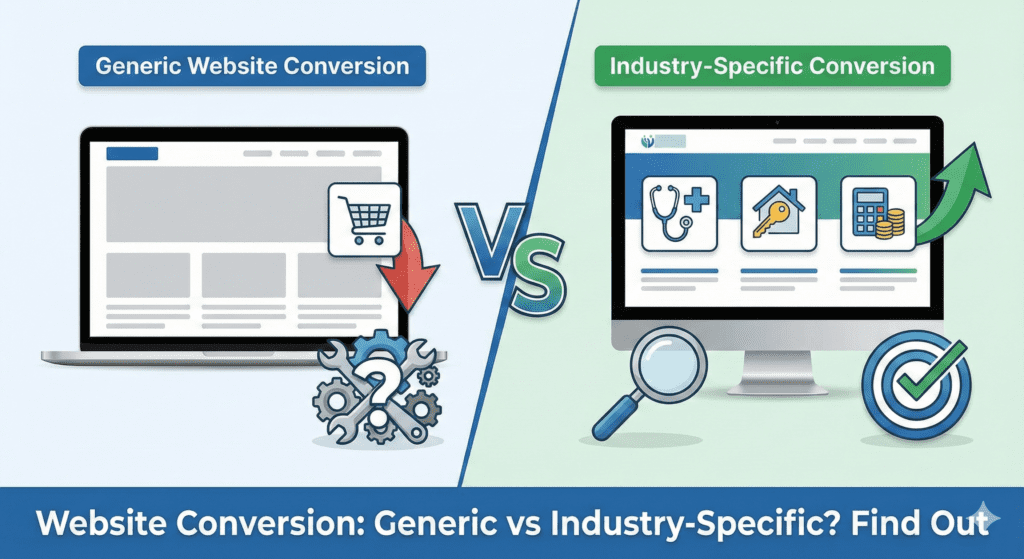
Generic Website vs Industry-Specific Website: Lead Conversion Comparison
The digital landscape offers various avenues for businesses to establish their online presence. The choice between a generic website and an industry-specific website often arises, particularly when considering strategies to enhance lead conversion. This comparison explores conversion rates, user intent, CTA personalization, and ultimately, the cost versus ROI associated with each approach.
Understanding User Intent and Website Focus
A generic website aims to cater to a broad audience with general information. In contrast, an industry-specific website is tailored to a niche market, providing specialized content and solutions. As a result, the user intent visiting these sites differs significantly. Generic websites attract users with varying needs, while industry-specific websites draw users actively seeking solutions within a particular sector.
This clarity of intent is crucial for effective lead conversion.
Lead Conversion Data: Industry-Specific Websites Lead the Way
Numerous studies demonstrate that industry-specific websites tend to achieve higher lead conversion rates compared to generic counterparts. This advantage stems from their ability to address specific pain points, demonstrate expertise, and offer tailored solutions.
Think about it; someone searching for “best accounting software for small businesses” is more likely to convert on a site dedicated to accounting solutions than on a general business advice website. Therefore, a dedicated approach often yields better results.
Conversion Data Logic
Lead conversion data on industry-specific websites stems from highly targeted user intent. The user already has a problem they need to solve, and an industry-specific website immediately addresses this, cutting down the research phase and increasing the likelihood of lead capture.
Optimizing Call-to-Action (CTA) Personalization
Effective CTAs are essential for driving conversions. Industry-specific websites have the upper hand in this area due to their deeper understanding of their target audience. They can craft personalized CTAs that resonate with the specific needs and challenges of users in their industry.
Generic websites often rely on broad CTAs, which may not be as compelling for users seeking specialized solutions.
The Cost vs. ROI Equation
While developing an industry-specific website may require more initial investment due to its specialized content and functionality, the higher conversion rates often translate to a better return on investment (ROI).
Generic websites may be cheaper to build initially, but their lower conversion rates can result in higher customer acquisition costs over time. Moreover, it’s important to track your ROI to determine if the initial cost to create an industry specific website is actually worth it.
User Intent Mapping
Mapping user intent on an industry-specific website is often more straightforward. Understanding the nuances of a specific industry allows for a more tailored website architecture and content plan that directly addresses the user’s search query. This leads to increased engagement and a higher propensity for lead conversion.
SEO Considerations and Content Strategy
Industry-specific websites can benefit from targeted SEO strategies focused on relevant keywords and long-tail queries within their niche. This enables them to attract highly qualified traffic and improve their search engine rankings. Generic websites face a greater challenge in ranking for competitive keywords across diverse topics.
Case Studies and Examples
Consider a law firm specializing in intellectual property law. Their industry-specific website showcases their expertise, case studies, and specialized services, attracting clients seeking legal counsel in this specific area. A generic law firm website, on the other hand, may struggle to attract such targeted leads.
Conclusion: Maximizing Lead Conversion with Targeted Websites
Ultimately, the choice between a generic website and an industry-specific website depends on your business goals and target audience. If you’re looking to maximize lead conversion and establish yourself as an authority in your niche, an industry-specific website is a strategically advantageous choice. Invest in a well-designed and optimized industry-specific platform to see superior results.
FAQ: Understanding Industry-Specific Websites and Lead Conversion
- What is an industry-specific website? An industry-specific website caters to a niche market, offering specialized content and solutions related to a particular industry.
- Why are industry-specific websites better for lead conversion? They address specific pain points, demonstrate expertise, and offer tailored solutions, leading to higher engagement and conversion rates.
- How does user intent affect website conversion rates? Clear user intent, as seen with industry-specific website visitors, increases the likelihood of conversion as users are actively seeking solutions within that niche.
- Are industry-specific websites more expensive to build? They may require more initial investment due to specialized content and functionality, but the higher conversion rates often translate to better ROI.
- What are some key elements of a successful industry-specific website? Specialized content, targeted SEO, personalized CTAs, and a focus on addressing the unique needs of the target audience.
- How can I track the ROI of my industry-specific website? Monitor key metrics such as lead generation, conversion rates, and customer acquisition costs. Compare these with your initial investment.
- What role does CTA personalization play in lead conversion? Personalized CTAs resonate with the specific needs and challenges of users, making them more likely to take action.
Ready to supercharge your lead generation? Contact us today for a consultation on building a high-converting industry-specific website!
