
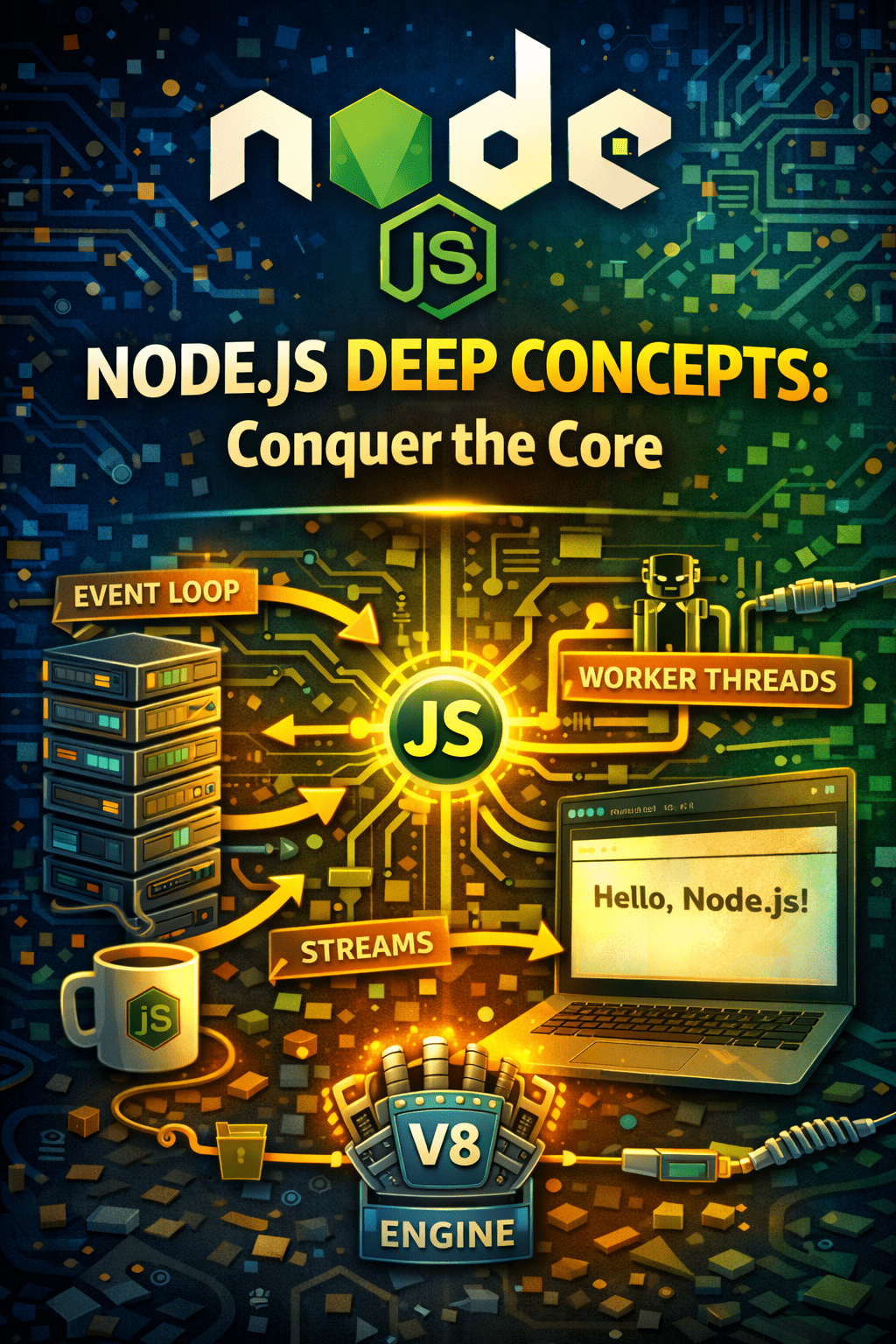
Node.js Deep Concepts: Master the Core
Node.js has become a cornerstone of modern web development, but to truly harness its power, it’s crucial to understand Node.js deep concepts. This article dives into advanced topics, including the event loop, clusters, streams, memory management, and how Node.js handles concurrency internally. Understanding these topics will allow you to build robust, scalable, and performant applications.
The Event Loop: Beyond the Basics (Advanced)
The event loop is the heart of Node.js’s non-blocking, asynchronous nature. It continuously monitors the call stack and task queue, executing callbacks when the stack is empty. However, a deep dive reveals nuanced phases, including timers, pending callbacks, idle, prepare, poll, check, and close callbacks.
Understanding these phases is critical for optimizing event loop performance. For instance, long-running synchronous operations in the poll phase can block the event loop, leading to performance issues.
Therefore, breaking down large tasks into smaller, asynchronous chunks is vital.
Understanding the Poll Phase
The poll phase retrieves new I/O events; executing their corresponding callbacks. If no active timers are present and the poll queue is empty, Node.js will wait for new incoming connections, essentially sleeping. This conserves resources.
Clusters and Worker Threads: Scaling Node.js
Node.js, by default, runs on a single thread. To leverage multi-core processors, Node.js provides the `cluster` module. This module allows you to create multiple Node.js processes (workers) that share server ports.
Each worker runs independently, handling requests concurrently. Another approach is the use of `worker_threads` which allow running multiple threads within a single Node.js process. Clusters create whole new processes, whereas worker threads share memory space.
Worker threads are thus great for CPU-bound tasks. Using clusters is an effective way to scale your applications horizontally.
Streams and Pipelines: Efficient Data Handling
Streams are a powerful way to handle large amounts of data efficiently. Instead of loading entire files into memory, streams process data in chunks. Pipelines, built using the `pipeline` utility, simplify the creation of complex streaming workflows.
These workflows connect multiple streams together, ensuring data flows seamlessly from one stream to the next. For example, you could pipe data from a file stream to a gzip stream to a network stream, compressing the data as it is sent over the network.
Furthermore, streams can improve the application’s memory footprint.
Memory Management and Garbage Collection: Preventing Leaks
Node.js utilizes the V8 JavaScript engine, which includes an automatic garbage collector. However, memory leaks can still occur if objects are unintentionally kept alive, preventing the garbage collector from reclaiming them. Understanding how V8 allocates memory and how the garbage collector works can help prevent these leaks. Use tools like the Node.js inspector to profile your application’s memory usage and identify potential issues.
Common Memory Leak Patterns
Common memory leak sources include closures referencing large objects, global variables accumulating data, and detached DOM elements in browser-based Node.js applications (using frameworks like Electron). Regular code reviews and memory profiling can help detect and prevent these issues.
How Node.js Handles Concurrency Internally
Node.js achieves concurrency through its event loop and non-blocking I/O operations. When a long-running I/O operation is initiated, Node.js doesn’t wait for it to complete. Instead, it registers a callback function and continues executing other code.
When the I/O operation finishes, the callback is added to the event queue and eventually executed by the event loop. This approach allows Node.js to handle many concurrent connections efficiently. Moreover, the use of libuv offers consistent abstractions for the low level OS functions.
Conclusion
Mastering Node.js deep concepts is essential for building high-performance, scalable, and maintainable applications. By understanding the event loop, clusters, streams, memory management, and concurrency model, you can optimize your Node.js code and take your development skills to the next level. Embrace continuous learning and experimentation to unlock the full potential of Node.js.
Ready to elevate your Node.js skills? Dive deeper into these advanced concepts and start building better applications today!
Frequently Asked Questions (FAQ)
Here are some common questions about Node.js deep concepts: Node.js Performance Optimization: Boost App Speed Now! Node.js Core Concepts Explained | Developer's Guide Optimizing Livewire Components for Performance in Livewire 3.0