Google Ranking vs. Leads: Are You Missing Out?
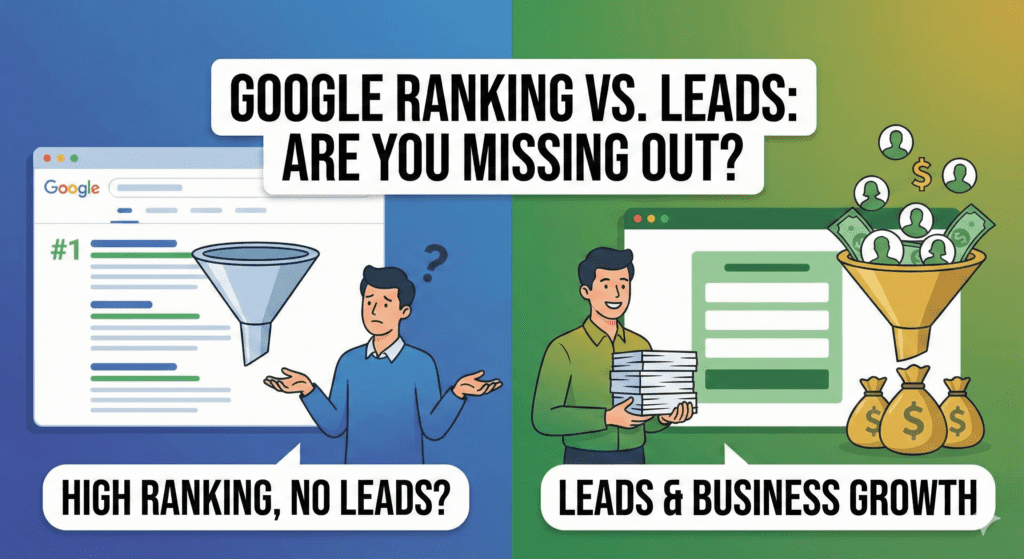
Why Google Ranking Alone Doesn’t Bring Leads
Achieving a high Google ranking alone is a fantastic accomplishment and a testament to effective SEO strategies. However, many businesses find that even with top rankings, the influx of leads they expected never materializes. This raises a crucial question: why isn’t ranking at the top translating into tangible business growth?
The Traffic-to-Lead Disconnect
Just because your website appears at the top of Google search results doesn’t guarantee that visitors will become customers. Think of your website as a store. A prime location (high ranking) is great, but if the store isn’t appealing or easy to navigate, people will walk away without buying anything. High rankings drive traffic, but converting that traffic into qualified leads requires a comprehensive strategy. So, let’s explore why Google ranking alone isn’t enough.
Website User Experience
A poor user experience can deter potential leads. If your website is slow, difficult to navigate, or not mobile-friendly, visitors will quickly leave, regardless of your ranking. Consider optimizing your website’s design, content, and speed for a better user experience. Furthermore, ensure your site is responsive and works well across all devices.
Focusing on the Wrong Keywords
Are you targeting keywords that attract the right kind of traffic? It’s possible to rank for terms that are irrelevant to your target audience. For instance, ranking high for a broad term like “software” might bring in lots of unqualified visitors. However, ranking for something more specific, such as “CRM software for small businesses,” could bring in a smaller but more valuable audience. So, revise your strategy.
Content That Doesn’t Convert
Your website’s content should address the needs and pain points of your target audience. If your content is generic or doesn’t offer clear solutions, visitors are unlikely to engage further. Create content that’s informative, engaging, and tailored to the different stages of the buyer’s journey.
Neglecting Call-to-Actions (CTAs)
Even the most compelling content won’t generate leads if you don’t have clear and prominent calls-to-action. Guide visitors toward taking the next step, whether it’s signing up for a newsletter, downloading a whitepaper, or requesting a demo. Strategic placement and compelling copy are key to effective CTAs.
The Importance of Lead Magnets
Offering valuable resources in exchange for contact information is a powerful way to generate leads. Lead magnets, such as ebooks, checklists, or templates, provide value to your audience while allowing you to capture their information for future nurturing.
Not Nurturing Your Leads
Lead generation is only the first step. You need to nurture your leads through targeted email marketing, personalized content, and ongoing engagement. Building relationships with potential customers increases the likelihood of converting them into paying clients.
Analyzing and Optimizing Your Conversion Funnel
Regularly analyze your website’s analytics to identify areas for improvement. Track key metrics like bounce rate, time on page, and conversion rates to understand how visitors are interacting with your site. A/B testing different elements, such as headlines, CTAs, and landing pages, can help you optimize your conversion funnel.
Conclusion: Beyond the Ranking – Focusing on Conversions
While achieving a high Google ranking alone is essential, it is only one piece of the puzzle. To transform website traffic into tangible leads, you must focus on user experience, targeted keywords, compelling content, strategic CTAs, and consistent lead nurturing. By adopting a holistic approach to your marketing strategy, you can maximize the ROI of your SEO efforts and drive sustainable business growth.
FAQ
High rankings drive traffic, but user experience, content relevancy, and the absence of clear CTAs can hinder conversions.
Focus on creating targeted content, optimizing user experience, implementing strong CTAs, and nurturing leads through email marketing.
Very important. Slow websites lead to high bounce rates and lost potential leads.
Lead magnets are valuable resources offered in exchange for contact information, helping you capture leads for future nurturing.
Analyze your website traffic and conversion rates to determine if your traffic consists of unqualified visitors.
Track bounce rate, time on page, conversion rates, and click-through rates to identify areas for improvement.
Focus on optimizing conversion elements, improving the website UX, and actively nurturing leads.
[Internal Link Suggestion: Link to a relevant blog post on lead generation or conversion rate optimization.]
Ready to convert your website traffic into qualified leads? Contact us today for a free consultation! Instagram Followers: Why They Aren't Buying Your Product
