
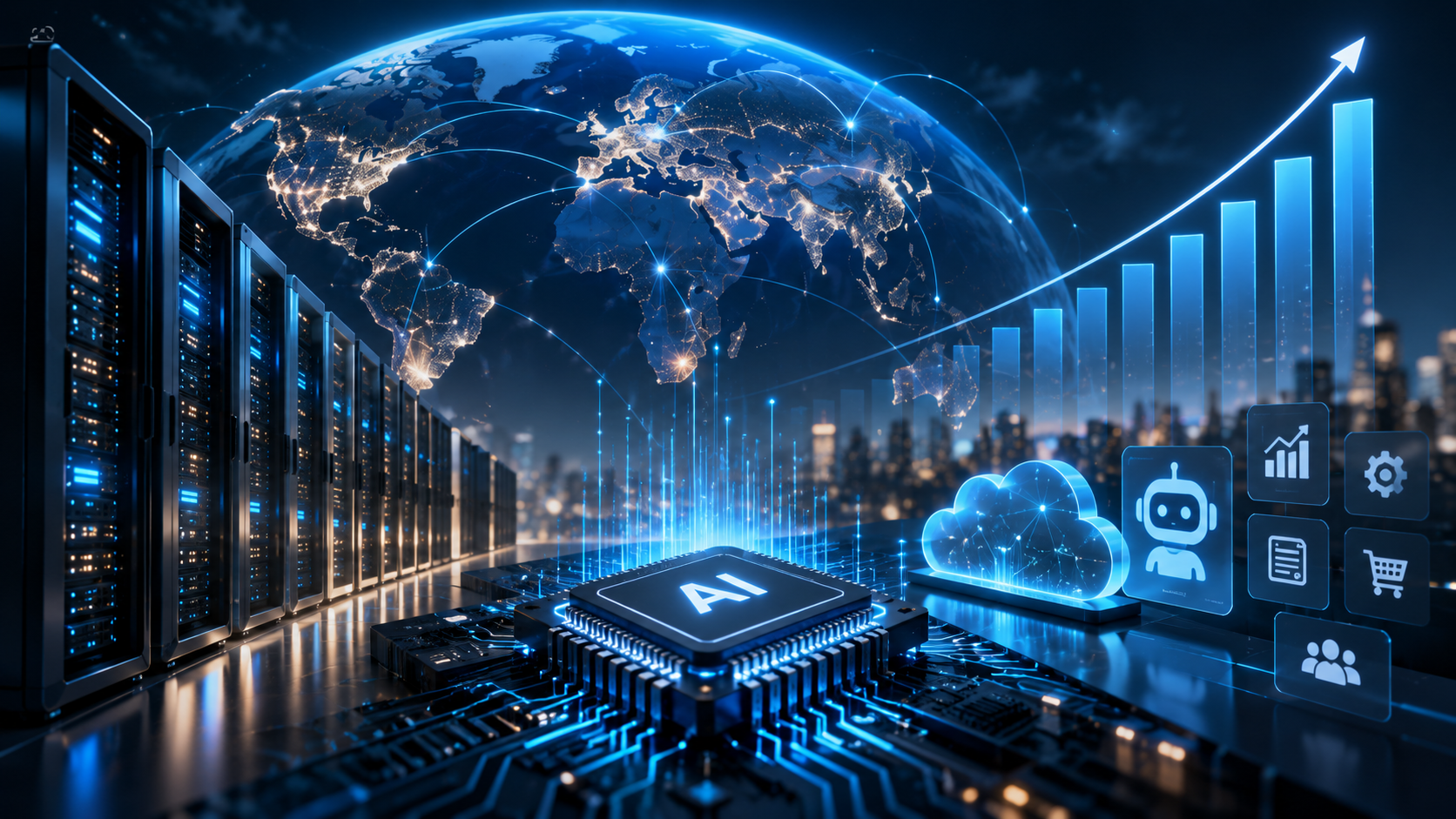
AI Spending Is Set to Reach $2.7 Trillion in 2026: What It Means for Businesses
Artificial intelligence is moving rapidly from an experimental technology into a major part of business infrastructure.
According to a new forecast from Gartner published on September 16, 2026, worldwide spending on artificial intelligence is expected to reach $2.7 trillion in 2026, representing a 49.5% increase compared with 2025.
The forecast reflects a broader shift in the technology industry: businesses are increasingly spending not only on AI models, but also on the infrastructure, software and services required to put AI into real-world workflows.
AI Spending Is Growing Across the Technology Stack
The current AI boom is no longer limited to companies building large language models.
Businesses are investing across multiple layers of the AI ecosystem, including:
AI computing infrastructure
Data centers and specialized processors
Cloud AI services
Generative AI applications
AI-powered enterprise software
AI agents and automation
Data management and analytics
AI security and governance
Gartner describes the combination of AI infrastructure investment and the embedding of AI into software and services as major drivers behind the growth.
AI Is Becoming Part of Everyday Business Software
One of the most important changes is the transition from AI as a separate tool to AI as a built-in capability.
Instead of employees opening a separate AI chatbot to complete a task, AI is increasingly being integrated directly into the applications they already use.
For example:
CRM software → AI-generated customer summaries
E-commerce → AI product recommendations
Marketing platforms → AI-generated campaigns
Customer support → AI agents
Accounting software → automated analysis
Development tools → AI-assisted coding
Office applications → AI-powered document and data processing
This shift could make AI adoption less visible to users while making it more deeply integrated into business operations.
AI Agents Could Become the Next Major Growth Area
Generative AI initially focused heavily on generating text, images, audio and code.
The next phase is increasingly focused on AI agents that can perform multi-step tasks.
An AI agent can potentially:
Understand a user's request.
Break the task into smaller steps.
Use software tools and APIs.
Retrieve information.
Perform actions.
Evaluate the result.
Continue working until the task is completed.
This creates a different model of software interaction.
Instead of manually navigating multiple applications, a user could describe the desired outcome and allow an AI system to coordinate the required steps.
Recent product announcements from major AI companies show this direction clearly. OpenAI, for example, announced its Agents API on September 10, alongside other developments aimed at bringing AI deeper into business workflows.
Developers Are Also Seeing a Major Change
AI is also changing how software is built.
Modern coding assistants can help developers generate code, understand existing projects, identify problems and work through larger development tasks.
OpenAI's recent product and research announcements include developments around Codex, long-running software work and AI-assisted research.
This doesn't necessarily mean developers disappear.
Instead, the developer's role can shift toward:
Architecture
Requirements
Code review
Security
Testing
System design
AI-assisted implementation
The ability to work effectively with AI development tools is therefore becoming an increasingly important technical skill.
The AI Market Is Also Creating New Risks
Rapid AI adoption brings new challenges.
Organizations need to consider:
Data privacy
Security
AI-generated errors
Unauthorized AI usage
Hallucinations
Intellectual property
Access control
AI agent permissions
Regulatory requirements
Recent reports from Anthropic, for example, have documented attempts by threat actors to misuse AI systems for malicious activity, illustrating why AI security is becoming an increasingly important part of enterprise AI deployment.
Businesses therefore need to think about AI adoption as more than simply buying an AI tool.
They also need appropriate security, governance and human oversight.
What Does the $2.7 Trillion Forecast Mean?
The headline number is significant, but the more important trend is what the spending represents.
AI is increasingly becoming part of the underlying technology stack of businesses.
Companies are investing in:
Infrastructure → Models → Software → Agents → Automation
This could create opportunities for software companies, developers, cloud providers, AI startups and businesses that can successfully integrate AI into existing workflows.
For smaller companies, the opportunity may not be to build a new foundation model.
Instead, it may be to use existing AI capabilities to solve specific business problems.
What Businesses Should Watch Next
Several areas are likely to remain important as AI adoption continues:
1. AI Agents
Software that can perform tasks rather than simply answer questions.
2. AI Automation
Connecting AI with existing business systems and APIs.
3. AI Coding
Increasing integration of AI into software development.
4. AI Infrastructure
Growing demand for computing, data centers and specialized hardware.
5. Enterprise AI
Organizations moving AI from experimentation into production.
6. AI Security
Protecting data, models, agents and automated workflows.
7. AI Governance
Creating rules for how organizations use increasingly capable AI systems.
Final Thoughts
The forecast of $2.7 trillion in worldwide AI spending in 2026 is another indication of how quickly artificial intelligence is becoming embedded in the technology economy.
The next stage of the AI revolution may not simply be about creating increasingly powerful chatbots.
It may be about embedding intelligence into software, business processes and autonomous workflows.