
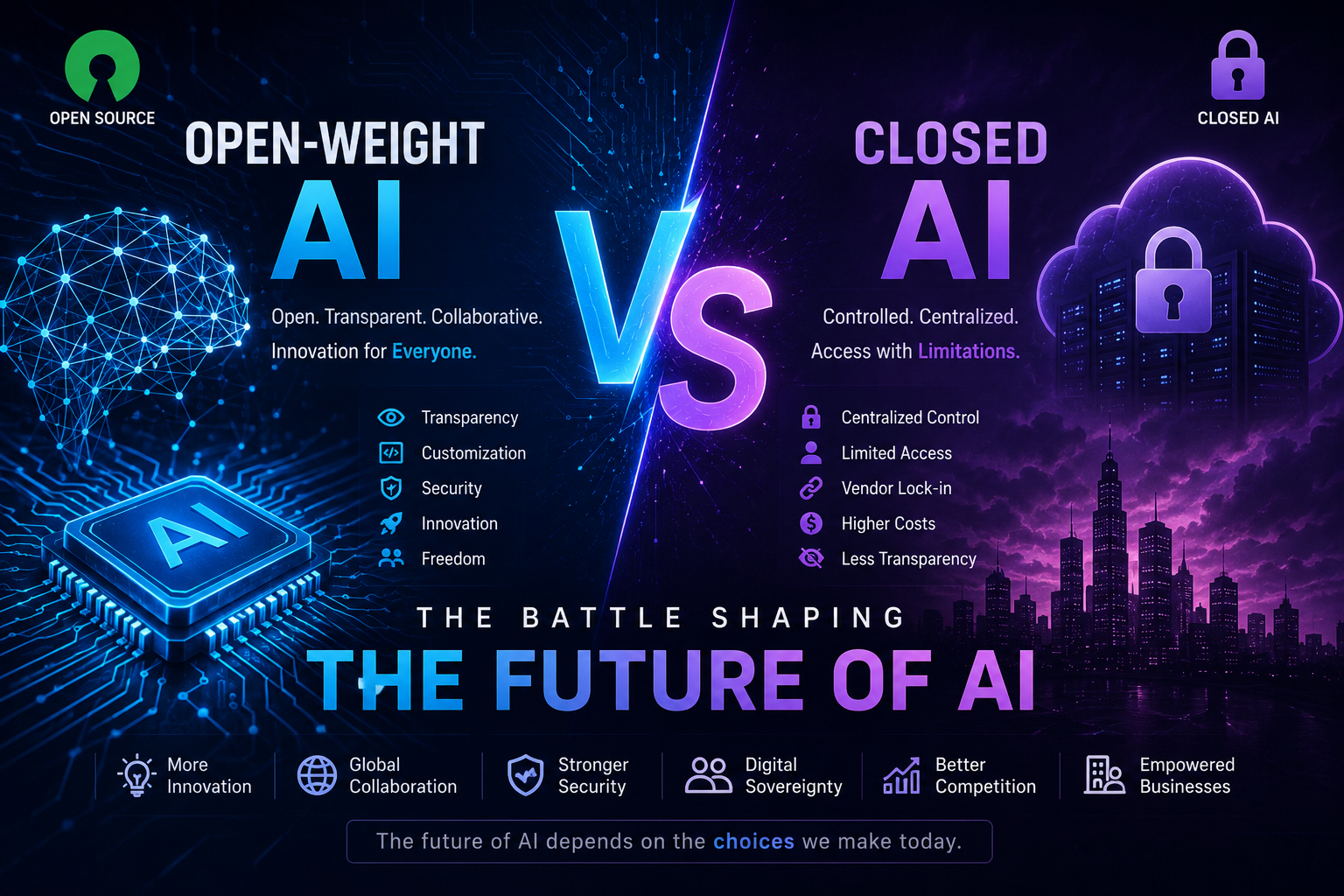
A New Battle Is Shaping the AI Industry
The artificial intelligence race is no longer just about building the most powerful models. It has now expanded into a debate over who should have access to those models.
On July 24, a coalition of major technology companies—including Microsoft, Meta, NVIDIA, Palantir, Mistral AI, Mozilla, and the Linux Foundation—called on U.S. policymakers to avoid broad restrictions on open-weight AI models. Their message is clear: open AI is essential for innovation, cybersecurity, competition, and national technological leadership.
Interestingly, two of the biggest AI companies—OpenAI and Anthropic—were not among the signatories.
What Is Open-Weight AI?
An open-weight model allows developers and organizations to download the trained model parameters ("weights") and run the model on their own infrastructure.
Examples include:
Meta's Llama family
Mistral AI models
Several open-source AI projects
By contrast, closed AI models are accessible only through APIs or proprietary applications, giving their creators full control over updates, pricing, and usage.
Why Are Companies Defending Open AI?
Supporters argue that open-weight AI delivers several important advantages:
Faster Innovation
Developers worldwide can improve models, create specialized versions, and build new applications without waiting for a single vendor.
Stronger Cybersecurity
Security researchers can inspect models for weaknesses, helping identify vulnerabilities before attackers exploit them.
Lower Costs
Organizations can run models on their own infrastructure, reducing dependence on expensive API pricing.
Digital Sovereignty
Governments and enterprises gain greater control over their AI infrastructure instead of relying entirely on foreign cloud providers.
The coalition argues that these benefits mirror how open-source software accelerated innovation over the past several decades.
Why Are Governments Concerned?
As AI systems become more capable, regulators worry about misuse.
Recent debates have focused on:
Autonomous AI agents
Cybersecurity risks
Model theft and unauthorized distillation
National security concerns
Potential misuse by malicious actors
These concerns have prompted lawmakers to explore stronger oversight of frontier AI systems. Recent legislative proposals in the United States reflect the growing interest in emergency powers for high-risk AI scenarios.
The Industry Is Becoming More Divided
The AI ecosystem is increasingly separating into two camps.
Open AI Supporters
Microsoft
Meta
NVIDIA
Mistral AI
Mozilla
Linux Foundation
Palantir
These organizations generally believe that open-weight AI encourages faster innovation and healthier competition.
Closed AI Leaders
Companies such as OpenAI and Anthropic primarily deliver their frontier models through managed services, emphasizing centralized safety controls and controlled deployment.
The debate is no longer purely technical—it has become a question of business models, regulation, and global competitiveness.
What This Means for Developers
For software developers, startups, and enterprises, the outcome of this policy debate could shape how AI is built over the next decade.
If open-weight models remain widely available, developers can expect:
More affordable AI solutions
Greater customization
Faster open-source innovation
Increased competition among model providers
If regulations become more restrictive, organizations may rely more heavily on commercial AI APIs, potentially increasing costs and reducing flexibility.
Final Thoughts
Artificial intelligence has reached a turning point.
The discussion is no longer only about which company has the smartest model. It is also about who gets to build with AI, who controls the underlying technology, and how innovation should be governed.
Whether policymakers ultimately favor open or closed approaches, today's debate will influence the future of software development, enterprise AI adoption, and global technological leadership for years to come.
Key Takeaways
Major technology companies are urging policymakers to avoid broad restrictions on open-weight AI.
Open-weight AI allows developers to run and customize models locally.
Supporters say openness accelerates innovation, cybersecurity, and competition.
Governments remain concerned about AI safety and national security.
The outcome of this debate could define the future direction of the AI industry.
Keywords: Open AI, Open-Weight Models, Artificial Intelligence, NVIDIA, Microsoft AI, Meta AI, AI Regulation, Open Source AI, AI Policy, Enterprise AI