
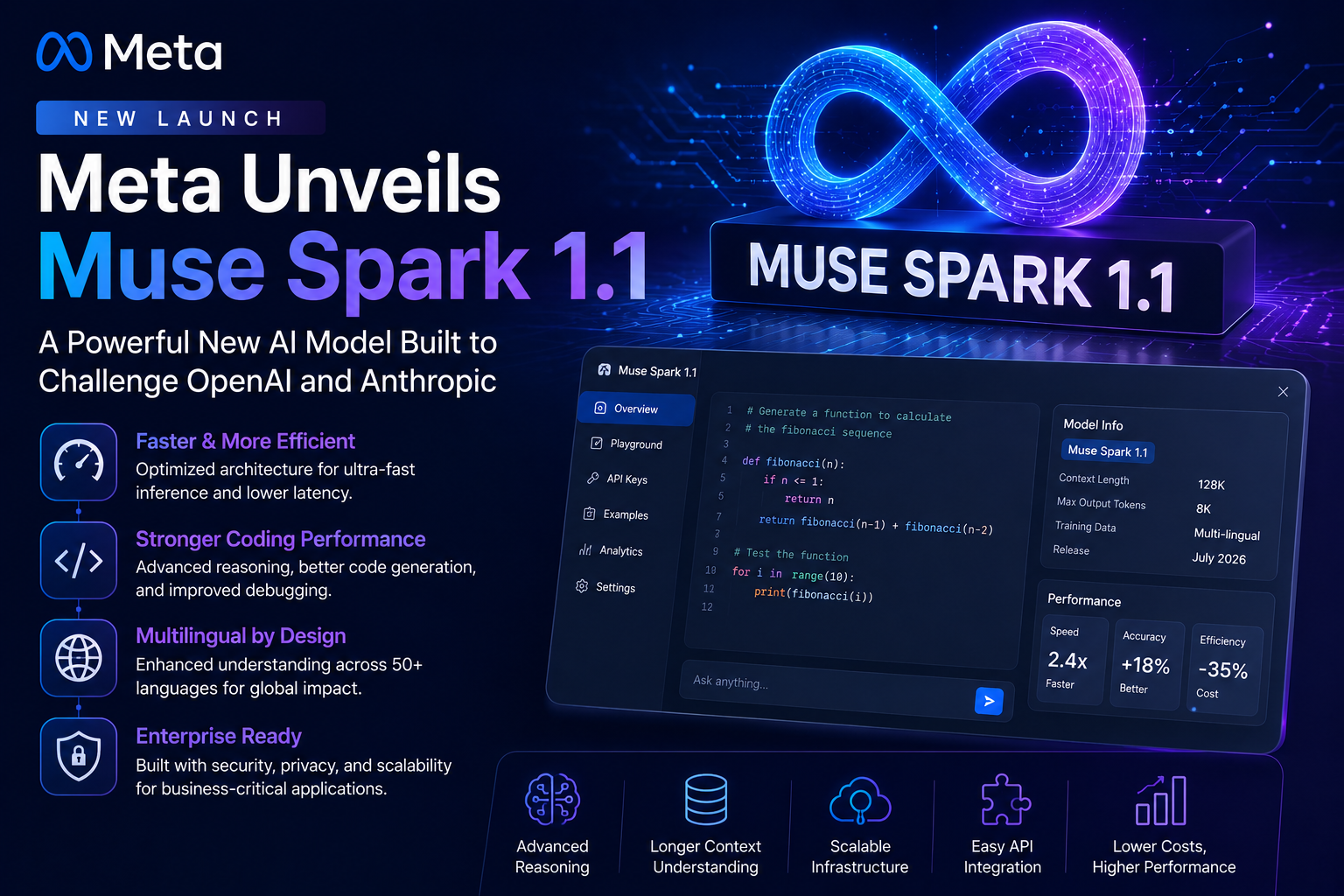
Meta Expands Its AI Ambitions with Muse Spark 1.1
The global AI race has entered another exciting chapter as Meta officially introduced Muse Spark 1.1, an upgraded large language model designed to compete with industry leaders including OpenAI, Anthropic, Google, Alibaba, and DeepSeek.
The announcement reflects Meta's continued investment in artificial intelligence following the success of its Llama family of models. Muse Spark 1.1 focuses on improving reasoning, software development, multilingual understanding, and enterprise AI applications while delivering faster responses and more efficient infrastructure utilization.
With billions of dollars invested in AI research and data center expansion, Meta is positioning itself as one of the world's largest AI platform providers.
What Is Muse Spark 1.1?
Muse Spark 1.1 is Meta's newest foundation model built for developers, enterprises, and AI-powered applications.
The model is designed to deliver:
Faster response times
Better logical reasoning
Improved software development capabilities
Larger context understanding
Lower inference costs
Enhanced multilingual support
Meta says the new architecture significantly improves performance compared to previous generations while making deployment more efficient for enterprise customers.
Built for Developers
One of the biggest focuses of Muse Spark 1.1 is software engineering.
Developers can use the model for:
Writing production-ready code
Code reviews
Bug detection
Documentation generation
API development
Unit test creation
Architecture recommendations
SQL query generation
As AI-assisted development becomes standard across the software industry, Meta aims to provide an alternative to proprietary coding assistants.
Improved Multilingual Capabilities
Unlike many earlier language models, Muse Spark 1.1 places a strong emphasis on multilingual understanding.
The model is designed to perform well across:
English
Spanish
French
German
Arabic
Hindi
Japanese
Korean
Chinese
Dozens of additional languages
This makes it suitable for organizations serving global customers and multilingual markets.
Enterprise Features
Meta is increasingly targeting enterprise customers that require secure, scalable AI deployments.
Potential business use cases include:
Customer Support
Automated ticket handling
Knowledge base generation
Live chat assistants
Marketing
Content creation
SEO optimization
Campaign planning
Product descriptions
Business Intelligence
Report summarization
Data analysis
Executive dashboards
Presentation generation
Software Development
AI coding assistants
Debugging
Documentation
Test automation
Open API for Developers
Meta is expected to expand access to Muse Spark 1.1 through developer APIs, making it easier to integrate the model into:
SaaS platforms
Mobile applications
Enterprise software
AI agents
Customer service platforms
Productivity tools
This strategy allows developers to build AI-powered experiences without creating their own foundation models.
Why This Launch Matters
The release of Muse Spark 1.1 demonstrates that competition in the AI industry is accelerating.
Businesses now have more choices than ever before, allowing them to select models based on:
Performance
Cost
Deployment flexibility
Security requirements
Ecosystem compatibility
This increased competition is expected to drive faster innovation and make advanced AI more accessible to organizations of all sizes.
The Bigger Picture
Meta's continued investment in AI infrastructure signals a long-term commitment to becoming a leading provider of artificial intelligence technologies.
As AI moves beyond chatbots toward autonomous agents and enterprise automation, companies are seeking models that are not only intelligent but also efficient, scalable, and cost-effective.
Muse Spark 1.1 is another step in that direction.
Final Thoughts
Meta's introduction of Muse Spark 1.1 highlights how quickly the AI landscape is evolving. With improvements in reasoning, coding, multilingual support, and deployment efficiency, the model strengthens Meta's position in an increasingly competitive market.
For developers, startups, and enterprises, the growing number of advanced AI models means greater flexibility to choose solutions that align with their technical requirements and business goals.
As competition intensifies between OpenAI, Meta, Google, Anthropic, Alibaba, and other AI leaders, users can expect even faster innovation, lower costs, and more capable AI systems in the months ahead.